
The Death Bloom
What the desert Agave has to teach us about growth.

As I drove into Santa Fe earlier this week, it is the first time I have traveled where there is no strong tether to home.
There is no one there, at home.
There is no traveling companion.
There is no traveling agenda.
For the first time in 18 years of parenting, I left a home without any children in it (they are both staying with their dad and driving and working), without any husband or boyfriend in it (they are busy living their own lives in their own time), and without any dog in it (Genji just passed).
A friend called on the drive and asked how it was going:
“It’s like being shot into outer space. It is so weird.”
I AM IN A DEATH BLOOM.
When I arrive at the house where I am staying, there is a large Agave plant in the backyard that takes my breath away. I don’t remember seeing it before as a standout show in this immaculate desert garden. Steve is a landscaper and he cares for the plants. Katie is a writer and both they, and their children, are kindhearted souls. It feels like home here—with softly worn books, and stacks of papers and three loving dogs. The massive Agave looms over the back patio like a desert snorkel, or the Eye of Horus.
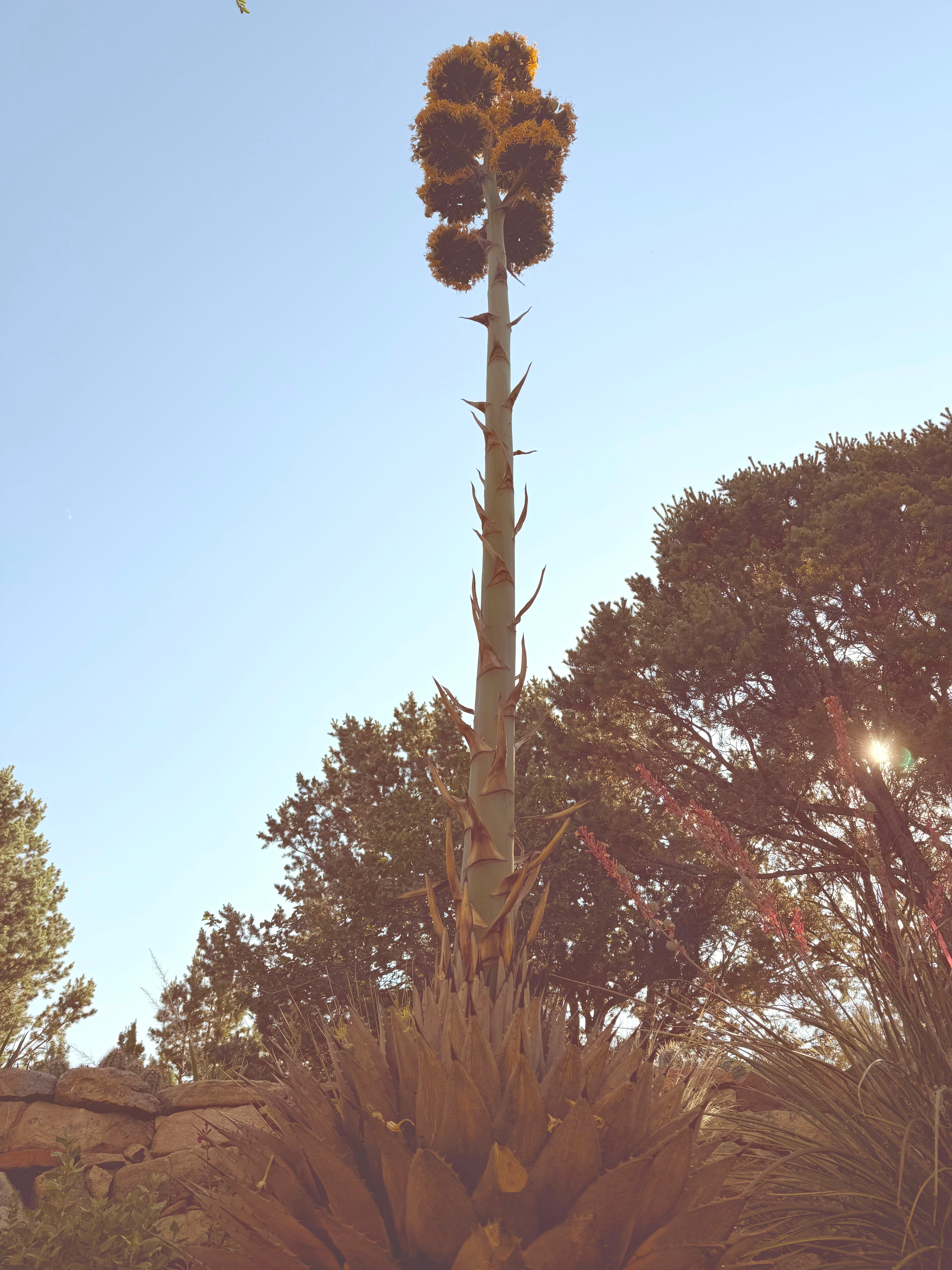
I ask Steve about it. He says he is waiting for the seeds to drop. I imagine this is something he does often, in his line of work. For a moment, I try to on his job–to be the midwife of the plants—the person who plants and grows and harvests and helps nature complete her cycle. Is this so different from my work with people and reading and writing?
He’ll know when it’s time to cut the stalk.
After Steve leaves, I research this massive beauty. Agave plants are monocarpic, meaning they spend anywhere from ten to thirty years storing energy before pushing up a single, massive flowering stalk.
An agave grows its flower stalk fast, anywhere from six to nine inches a day—by redirecting all the energy, sugars, and carbohydrates it spent decades storing in its thick leaves into one final reproductive push.
This process is known as a “death bloom” because the plant sacrifices its life to produce seeds.
While an agave’s vegetative life takes decades, the final blooming process is remarkably fast and follows a specific lifecycle:
Trigger: When mature, the plant funnels all its stored nutrients into a central asparagus-like spike. (See Steve’s agave picture!)
Growth Rate: The towering flower spike can shoot up between six to nine inches a day, eventually reaching heights of thirty to fifty feet.
Bloom Time: The blooming process can last up to a month, with flowers opening sequentially from the bottom to the top. The flowers attract pollinators like bees, bats, and hummingbirds.
Life Cycle Completion: Once the flowers produce seeds, the main parent plant slowly withers and dies. However, it leaves behind basal offsets (called “pups”) that continue the plant’s cycle (Source: Franklin Park Conservatory).
I AM IN A DEATH BLOOM.
I reread the map set forth by Agave and think about my own past year.
Trigger
Growth Rate
Bloom Time
Life Cycle Completion
My seeds are dropping…one by one by one…little pups landing in this stark sandy soil. Waiting to birth something new.
The bloom is not sudden. The stalk looks like an explosion — six to nine inches a day — but it’s actually the slowest thing the plant ever did. Thirty years of unglamorous storage, thickening leaves, photosynthesis nobody photographs. CAN I GET A HELL YEAH? I look up at her tower of yellow flowers and honor her patience.
The flowers open bottom to top, sequentially. Not all at once. A death bloom takes a month, and it doesn’t require me or you, or anyone, to know what the top flowers will look like while the bottom ones are opening. Whatever this year is asking of me, it’s asking sequentially. I only have to open the flower that’s next.
The bloom exists to feed others. Bats, bees, hummingbirds. The agave’s most extravagant act is also its most generous. That feels like relief. There is so much of being in a death bloom that shows up in a sensing body like aloneness, and like selfing, that this understanding is a relief to me. Maybe it is our most extravagant act to bloom, but maybe it is also our most generous. That feels counter to everything I have ever learned about what it means to take responsibility as a mother and a teacher.
The agave doesn’t actually die in any final sense; it relocates as its own seed. The little pups land in stark, sandy soil, waiting to birth something new. From the sky, I am watching them as the desert snorkel herself. I am the Eye of Horus, waiting patiently for each seed to go before I give signal to cut. my. Stalk.
If I am the stalk, maybe I am also one of my own seeds.
I am a woman alone in Santa Fe with no agenda. I am also the basal offset in new soil, at the very beginning of another cycle.
I am beginning again—preparing for decades of storage and sun and sugar and wind.
I love this! The beauty, the pain, the letting go, all part of the same cycle. Cheers to the rebirth and beginning again. I'm here for it.
🤮